

Customer Request
 Adient Slovakia, at its Lučenec plant, needed to meet its customer’s requirement to label its products with RFID tags. Products equipped with RFID tags undergo a demanding manufacturing process, so it was necessary to find a way to verify that the RFID tags had not been damaged during production, to encode the information required by the customer into the tags, and finally to verify that the shipping package does not contain any unlabeled or incorrectly labeled items.
Proposed Solution
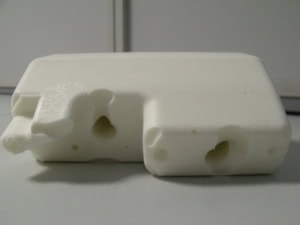 During the production of foam headrests, a label containing an RFID tag is inserted directly into the mold. During the foaming process, the label is exposed to higher temperatures and pressure, which can cause damage in some cases. Therefore, at the visual inspection station for finished products, a special POKA YOKE station is used to first verify the readability of the RFID tags; if they are readable, the data requested by the customer is then programmed into them. A Poka-Yoke station is a device that ensures no product with an incorrect serial number or a malfunctioning RFID chip passes through the workstation. If such a product is detected, the Poka-Yoke station remains locked and prevents the operator from removing the products until the foreman arrives; the foreman must then unlock the station and scrap the non-conforming product.
The inspected products are gradually placed into an eco-pack, which, once full, is transferred to the Shipping department. At the Shipping Department, the entire eco-pack is unloaded to verify the total number of products and ensure the accuracy of the data recorded in relation to the shipping order.
POKA YOKE Station
 The inspection station was equipped with a custom-built fixture that incorporates inspection elements such as RFID antennas, an RFID reader, pneumatic locks, presence sensors, and discrimination sensors. The fixture was designed to inspect and record three products simultaneously. The entire fixture is connected to a touchscreen PC, through which it is controlled.
After a visual inspection, the worker places the products into the fixture and starts the inspection and recording process, thereby locking the products in the Poka-Yoke station. Using sensors, the system identifies the product, and based on this, the software uses RFID antennas to write the production number assigned to that product onto the RFID chips. If the information is written successfully, the station unlocks the products, which the worker can then remove and place into an eco-pack. Once the eco-pack is full, it can be moved to the Shipping department. If the recording fails due to a damaged or missing RFID chip, the system keeps the products locked. This ensures 100% quality of the shipped products.
Shipping
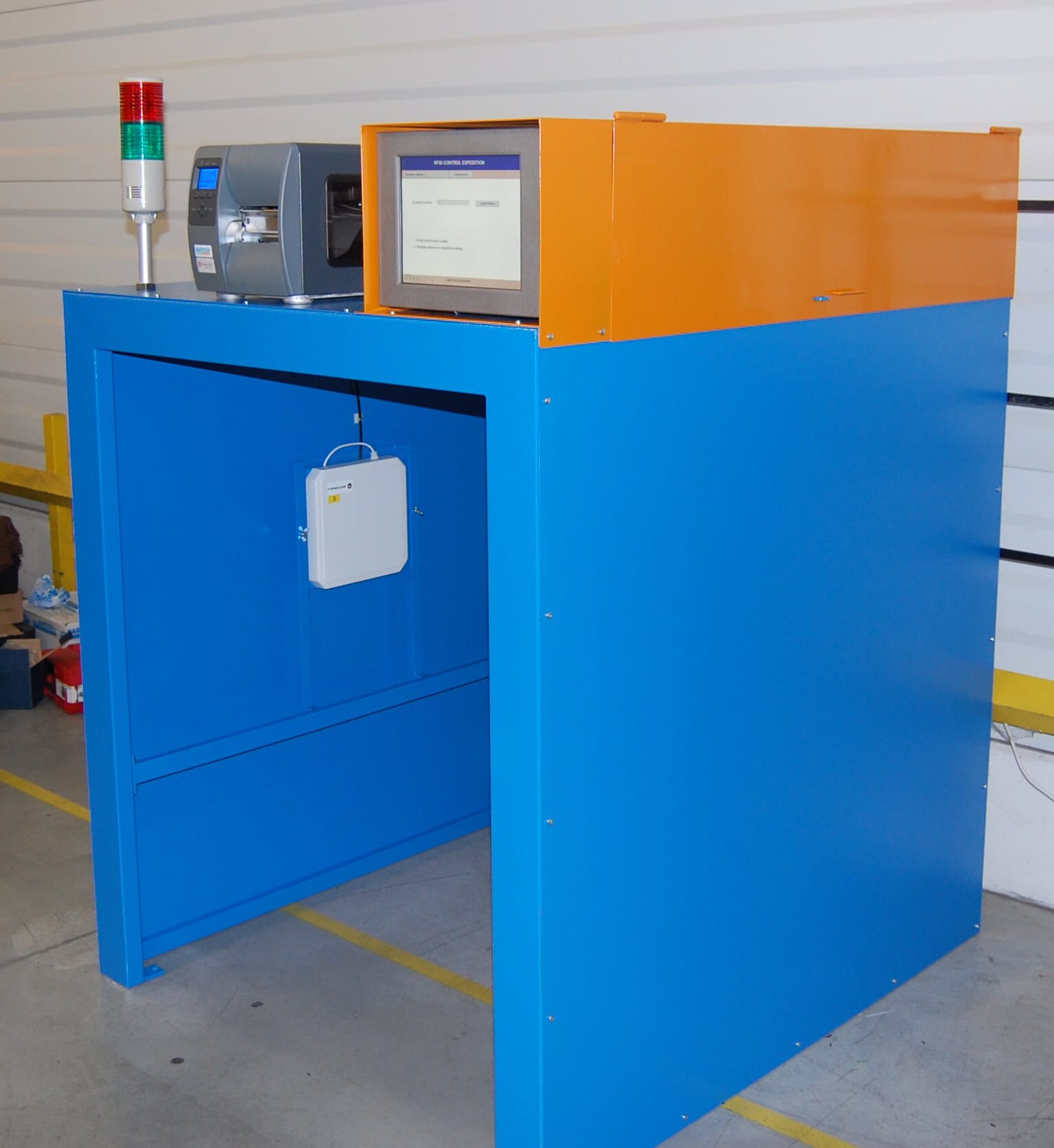 The shipping station consists of a metal gate into which the entire eco-pack is inserted. RFID antennas are mounted inside the metal gate and connected to a ZEBRA FX9600 RFID reader, which is linked to a computer.
Software running on the computer controls the entire process. After inserting the eco-pack into the gate, the worker starts the scanning process on the touchscreen. The antennas gradually scan the entire contents of the eco-pack and send the scan data to the PC. The software then verifies whether the eco-pack contains the exact number of products specified in the packing list. If the final count matches, the printer prints the required label, which includes the barcode needed to ship the entire eco-pack.
If the number of products scanned does not match the number specified on the packing slip, the software will not print the label, and therefore the shipment cannot be completed. This ensures that only products that are 100% labeled are shipped, and in the exact quantities specified.
Delivery of the Solution
Delivery of the complete solution for both sites took approximately 8 weeks.
The project was carried out in collaboration with the engineering firm JUS Nižná. The most important part of the entire project was the final fine-tuning of the antennas’ performance and direction at each workstation, which took two days during the installation of the equipment at the customer’s site. During the installation, a supervisor was trained to assist with the fine-tuning, thereby gaining the necessary experience to fully utilize the potential of this solution.